Quick Answer
An AI automation consultant is a founder-led operator who maps the work in week 1, then builds on your stack in fractional hours. You hire this when you need production systems, not a slide deck and not a 40-hour-a-week agency bench. em8 is a founder-led studio in Mora. Week-1 diagnostic is 8–12 hours. A build sprint is 12–20 hours. A retainer is 8 hours a week. Hire an agency when you have parallel workstreams or a year of 40-hour weeks. Hire a freelancer when the job is one tool and one owner. Q4 2026 is open.
What you actually hire
The title is noisy. “AI automation consultant,” “AI studio,” “fractional operator.” What you are buying is simple: someone who sits in your Slack, reads the real workflows, and ships a system you own.
I run em8 as a founder-led studio in Mora. Not a bench of juniors. Not a prompt wrapper with a landing page. The first week is a diagnostic. After that you buy hours against a scoped build, or you don’t. That is the whole product.
If you wanted the agency version of this story, start with what an AI automation agency actually does and the buyer’s guide. If the only tool in the brief is n8n, read how to hire an n8n expert instead. If the job is the CRM and the revenue system, read what a RevOps consultant hire actually is. This page is the consultant hire.
Consultant vs agency vs freelancer
Three different products. Mixing them is how you burn a quarter.
- Consultant (this). One senior operator. Week-1 diagnostic, then fractional hours. You get judgment, a scoped build, and handover. Best when the bottleneck is “who actually ships this,” not “we need five workstreams in parallel.”
- Agency. A team. Project managers, extra hands, coverage when someone is out. Costs more. Right when you have parallel workstreams, or you already know you need ~40 hours a week for a year. See automation agency pricing.
- Freelancer. A specialist for a bounded job: one integration, one tool, one owner on your side. Cheap and fast when the scope is honest. Fragile when the job turns into “rebuild GTM.”
I will tell you which of the three you are, including when it is not me.
Week 1 is a diagnostic, not a kickoff deck
Week 1 is 8–12 hours. I map where the hours actually go, which systems already exist, and which idea should never be automated. You leave with 1 or 2 concrete builds scoped, whether we work together after that or not.
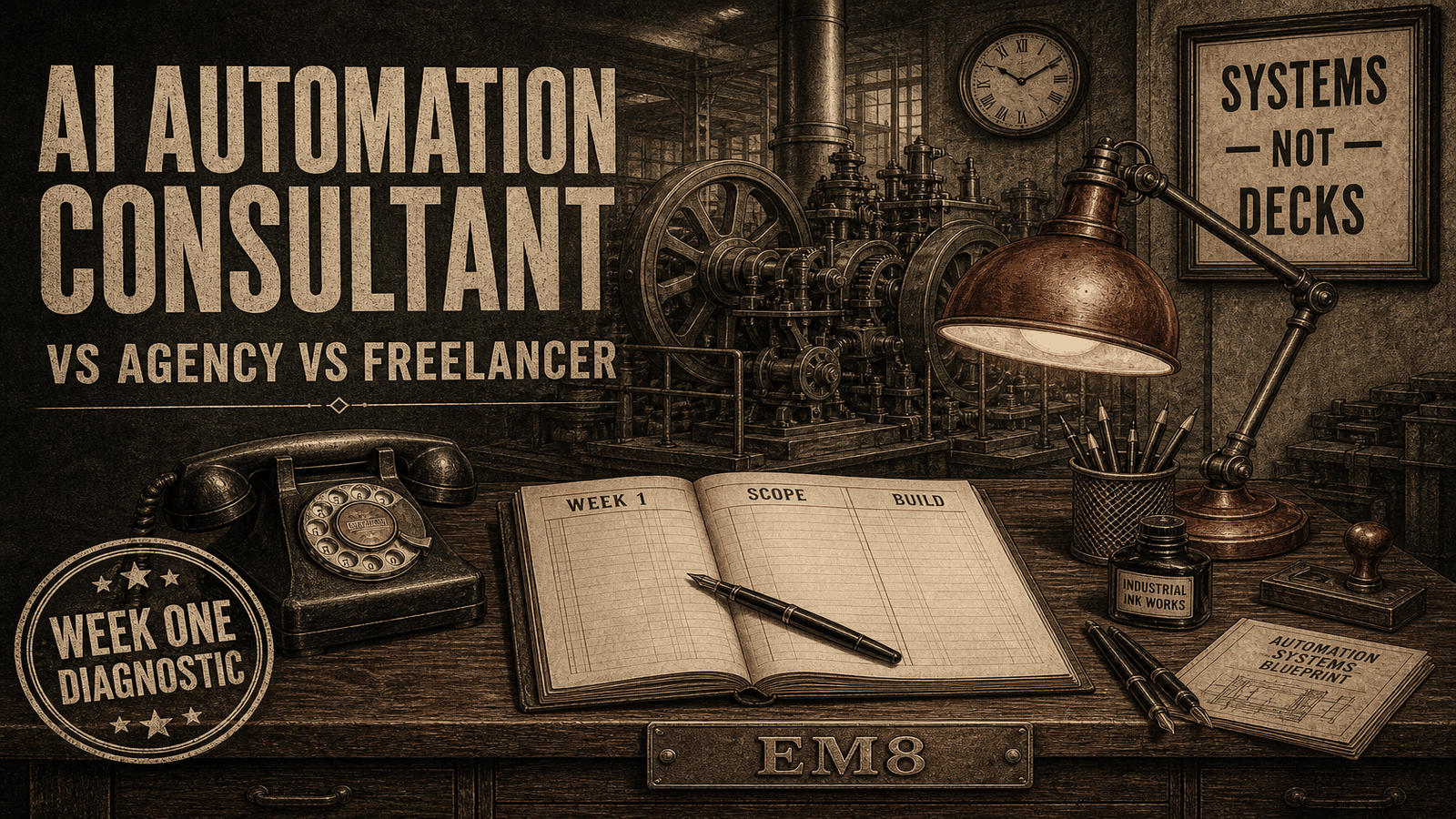
That is the filter. If someone quotes a 40-page “AI transformation” before they have sat in the workflow, you are buying slides. The wall in the studio says systems, not decks, for a reason.
Fractional hours, written plainly
You are not buying a 40-hour week. You are buying a senior slice that compounds. Run the numbers on the ROI calculator before you pick a row.
| Engagement | Hours | What you get |
|---|---|---|
| Diagnostic | 8–12h, week 1 | Map, red flags, 1–2 builds scoped. You keep the plan. |
| Build sprint | 12–20h | One production system, documented, credentials on your stack. |
| Retainer | 8h / week | Iterate, expand, keep it running. You still own it. |
If the work is bigger than that, you do not need a bigger consultant. You need an agency, or you need to cut the scope until one system is live.
What this looks like when it is real
Three live examples from the studio. Same operator, same rule: production, not a demo.
- Case 01, B2B sales org: outbound AI systems in three weeks. Cadence generator and proposal automation in production. About 50 hours per week automated, about $150k+ a year in unlocked sales capacity. Salesforce, SalesLoft, Claude.
- B2B podcast advertising agency: rate cards and pipeline intel lived in PDFs, decks, and scattered sheets. Turned into a 4,000-row Airtable that now powers daily deal flow.
- B2B SaaS: AI outbound from scratch. Warm-up for three weeks, then $45k in qualified pipeline in the first live week.
That is the consultant product. Hours in, systems out, you keep the keys.
Red flags
Walk if you see any of these.
- Prompt wrappers. A ChatGPT skin with your logo. No workflow, no evals, no owner when it fails on a Sunday.
- Zapier-only. Fine for a two-step sync. Not a sales system. If they cannot self-host, or will not, you are renting a brittle graph.
- No self-host option. When the data is yours, the runtime should be yours. n8n, Make, custom, whatever fits. The consultant who only lives in someone else’s cloud is a vendor.
When you should hire an agency instead
Hire an automation agency if you have parallel workstreams, or you already know you need ~40 hours a week for a year. A single consultant will become the bottleneck. That is not humility. That is capacity.
Hire a freelancer if the job is one tool and one owner. If the brief is “we only want n8n,” start at hire an n8n expert. Do not hire a studio to pretend it is a ticket shop.
Fit, and not-fit
Fit: mid-market B2B. Services, SaaS, media, education, consulting. An established GTM motor, enough scale that the operational drag is expensive, and an operator on your side who can say yes.
Not-fit: pre-revenue. There is nothing to automate except hope. Also not-fit: n8n-only scopes where you really want a specialist. Send those to the n8n guide. I would rather lose the work than build the wrong thing.
Frequently asked questions
What does an AI automation consultant actually do in week 1?
An 8–12 hour diagnostic. Map the hours, the stack, and the two builds that would move a number. You keep the plan even if we do not continue.
How is this different from an agency?
You hire one senior operator, not a bench. Faster loop, less coverage. Agency wins when you need parallel workstreams or a year of ~40h weeks.
How is this different from a freelancer?
A freelancer is right for a bounded tool job. A consultant owns the diagnostic, the scope, and the handover into a system you can run without them.
What does fractional actually mean?
Diagnostic 8–12h. Build sprint 12–20h. Retainer 8h a week. Not a disguised full-time seat.
Is Q4 2026 open?
Yes. Q4 2026 is open. Book a discovery call if the diagnostic is the right first week.
Come with the challenge. Leave with a plan.
30 minutes. No pitch. Q4 2026 is open. Tell me the one thing your revenue org spends too many hours on. We map 1 or 2 builds. You leave with a plan whether we work together or not.