AI Receptionist for Clinics: How One Installation Saved £70,000 in Year One
A dental practice replaced two part-time receptionists with an AI that books patients around the clock — and the savings were bigger than anyone expected.
The Phone Is Killing Your Clinic's Efficiency
Your receptionist picks up the phone, puts a patient on hold, types a note, transfers the call, answers a follow-up question about parking — and in between all of that, a new patient trying to book an emergency appointment gives up and calls your competitor.
That's not a staffing problem. That's a systems problem — and it's exactly the kind of repetitive, high-volume task that AI workflow automation is built to solve.
The average UK clinic receives 80–150 inbound calls per day. A significant portion of those are routine: appointment booking, rescheduling, opening hours, directions, service enquiries. Tasks that require no clinical judgment whatsoever — but still demand someone's full attention.
An AI receptionist removes that bottleneck entirely. It answers every call, instantly, and handles the entire booking flow without a human ever getting involved.
What Happened at One Dental Practice: £70,000 Saved in 12 Months
A multi-chair dental practice in the UK came to us with a specific problem: they were spending too much on front-desk staffing, missing calls during busy periods, and losing after-hours patients to practices that had online booking.
They had two part-time receptionists covering the phones — a combined cost of roughly £44,000 per year in wages, national insurance, and training. Neither was working evenings or weekends. Patients who called at 6pm on a Thursday heard a voicemail and, in many cases, didn't call back.
We installed an AI receptionist integrated directly into their existing booking system. Within 12 months:
- £44,000 saved in reduced reception headcount (one role not replaced after natural turnover)
- £18,000 in new revenue from after-hours bookings that previously went to voicemail
- £8,000 saved in eliminated overtime and agency cover during holidays and sick leave
- Total first-year impact: £70,000
The remaining receptionist shifted to patient-facing work — check-ins, treatment coordination, handling complex cases. The work she found more satisfying. The work that actually required a human.
How an AI Receptionist for Clinics Actually Works
The setup is simpler than most clinic managers expect. Here's the flow:
1. Call arrives on your existing number
Nothing changes for the patient. They call the same number they've always called. The AI answers within one ring, in a natural voice, using your clinic's name.
2. The AI identifies what the patient needs
Through conversation — not button-pressing menus — the AI understands whether the patient wants to book, reschedule, cancel, ask a question, or reach someone specific. It handles each scenario differently.
3. Booking happens in real time
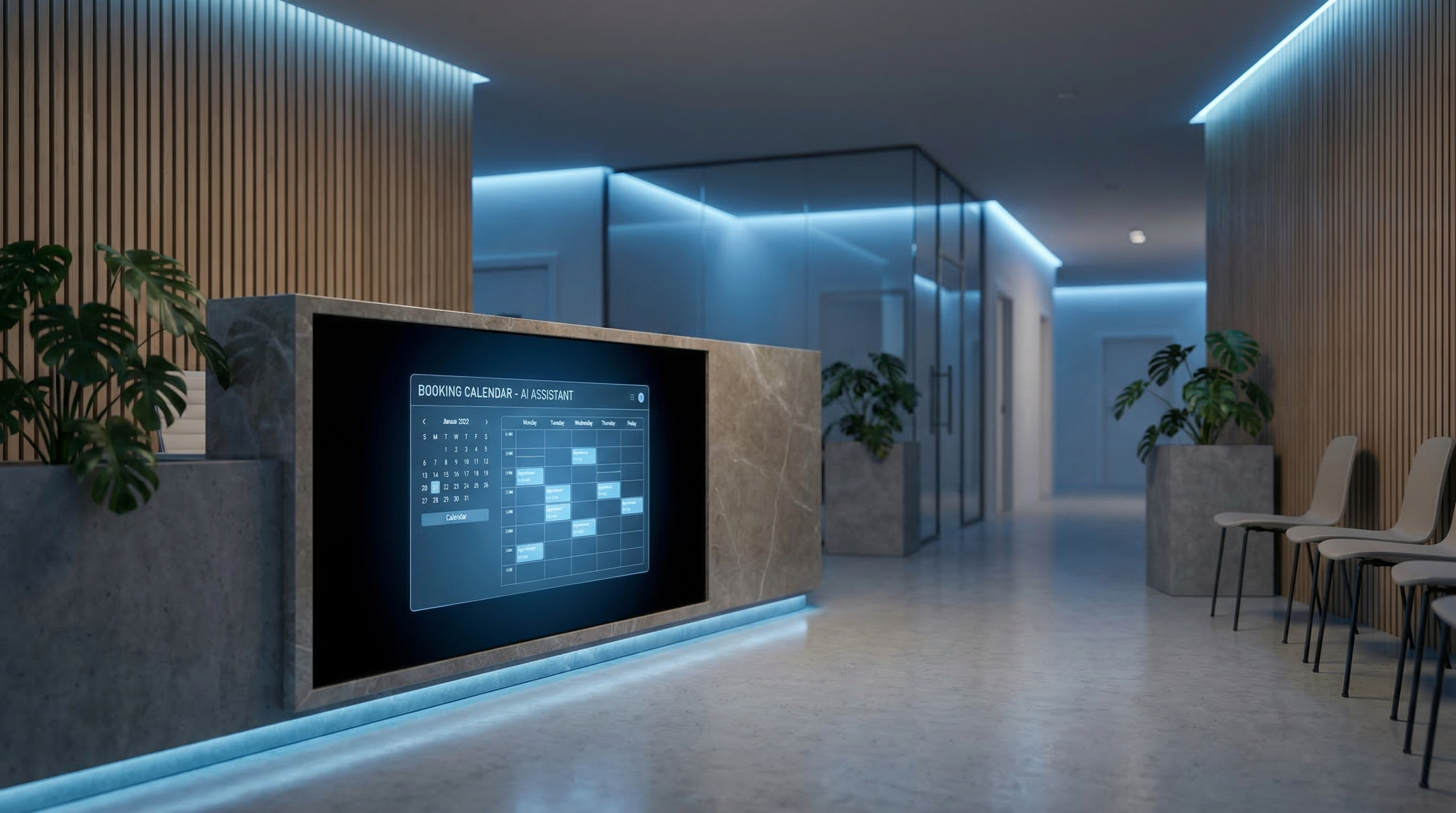
For appointment requests, the AI checks your live calendar, offers available slots, confirms the patient's details, and creates the booking — all within the same call. The patient gets a confirmation text automatically. Your team sees a new booking in the system as if staff had taken it manually.
4. Urgent calls get escalated immediately
The AI is trained to recognise clinical urgency. If a patient describes symptoms that need same-day attention, the call routes to a human immediately. Nothing gets filtered that shouldn't be.
5. Calls outside hours are handled, not lost
At 8pm on a Sunday, the AI still answers. It books the appointment for first thing Monday, sends the confirmation, and logs the interaction. When your team arrives in the morning, the diary is already full.
The After-Hours Problem Most Clinics Ignore
Here's a number that surprises most clinic owners: 67% of appointment requests come in outside standard working hours.
Think about that. Two thirds of the people trying to book with you are calling when no one is available to answer. Some leave a voicemail. Most don't.
The practices capturing those patients aren't necessarily better at dentistry, physiotherapy, or aesthetics. They're just better at answering the phone.
An AI receptionist that operates 24 hours a day doesn't just reduce costs — it grows the top line. Every after-hours call that converts to a booking is revenue your manual setup was leaving on the table.
In the clinic case study above, the £18,000 in new revenue came entirely from bookings made between 6pm and 9am. Calls the old system simply couldn't take.
What Types of Clinics Benefit Most?
AI receptionists work across the full range of clinic types, but certain practices see the fastest return:
Dental practices
High call volume, largely routine enquiries, strong patient lifetime value. Dental practices also tend to have predictable booking patterns, making the AI's calendar management particularly effective. UK data from 2025 suggests 65% of dental practices will be using AI receptionists by the end of the year.
Physiotherapy and sports clinics
Patients often self-refer and want to book quickly after an injury. Missing those calls means they book with whoever answers. An AI receptionist captures the booking in the moment of intent.
Aesthetic and cosmetic clinics
High-value treatments, price-sensitive enquiries, and patients who research outside business hours. An AI that can answer questions about procedures, quote treatment times, and book consultations is particularly valuable here.
GP surgeries and primary care
One NHS primary care implementation in South East England deployed AI to handle inbound calls for a 14,500-patient practice. The system answered 100% of calls within 3 rings — compared to a previous average wait of 36 minutes — and handled 82% of calls autonomously. The reception team reclaimed 15 work days per week.
What It Costs vs. What You Save
An AI receptionist installation typically runs £3,000–£6,000 for setup, depending on the complexity of your booking system and the number of call scenarios we need to handle. For a full breakdown of what automation projects cost, see our automation pricing guide. Monthly running costs are usually £300–£600.
Compare that to a single part-time receptionist at £22,000–£26,000 per year — and that's before employer NI, pension contributions, sick pay, and cover.
Most clinics recoup the setup cost within 6–10 weeks. After that, the savings accumulate month by month. Use our automation ROI calculator to estimate what your clinic could save.
| Cost item | Manual reception | AI receptionist |
|---|---|---|
| Annual staffing cost (1 FTE) | £26,000–£32,000 | £0 |
| Holiday + sick cover | £3,000–£8,000 | £0 |
| After-hours coverage | Not possible | Included |
| Setup cost (one-off) | £0 | £3,000–£6,000 |
| Monthly running cost | £2,100–£3,300/mo | £300–£600/mo |
| Year-one net saving | — | £20,000–£70,000+ |
The higher end of that range is where the after-hours revenue uplift comes in. If your clinic is actively losing after-hours bookings, the revenue recapture often exceeds the direct cost savings.
Common Concerns — Answered
"Patients won't want to talk to a robot"
This is the most common pushback, and the data doesn't support it. In multiple UK implementations, patient satisfaction scores were equal to or higher than with human receptionists. The reason: the AI answers immediately, never puts anyone on hold, and never has a bad day. Patients who've been waiting 20 minutes on hold before speaking to a human tend to find "answered in one ring by a friendly AI" a significant upgrade.
"What about complex enquiries?"
Anything outside the AI's training escalates to your team immediately. You define what "complex" means during setup — specific clinical questions, complaints, VIP patients, whatever applies to your practice. The AI handles the routine 80%, your staff handle the cases that actually need them.
"We already have an online booking form"
Online forms and AI phone receptionists serve different patients. Many people — particularly older demographics and those calling about urgent issues — prefer calling. They won't switch to a form just because you have one. The AI captures phone-first patients who your form was never going to convert.
"Our systems are complicated"
Most clinic management systems (Dentally, Exact, Carestream, Cliniko, and others) have integration options. We've connected AI receptionists to most major platforms. If yours is unusual, we scope it during the discovery call before committing to a timeline.
What the Setup Process Looks Like
From your first call with us to go-live is typically 2–4 weeks. Here's the breakdown:
- Week 1 — Discovery and scoping: We map your current call flows, identify the top 20 scenarios your receptionist handles daily, and audit your booking system integration options.
- Week 2 — Build and training: We configure the AI with your services, pricing (if relevant), FAQs, and escalation rules. The system is trained on your specific practice — not a generic clinic template.
- Week 3 — Testing: We run test calls across every scenario, including edge cases. You review and request changes. We iterate until it sounds exactly right.
- Week 4 — Soft launch: The AI goes live, typically on after-hours calls first while your team monitors. Once comfortable, we switch over daytime as well.
Your existing phone number stays the same. Patients notice no change except that someone always answers.
Is an AI Receptionist Right for Your Clinic?
It's the right fit if any of these apply:
- You're missing calls during busy periods
- You have no coverage outside working hours
- Your reception team spends more than 30% of their time on routine booking calls
- You're paying for overtime, holiday cover, or agency staff
- Your call abandonment rate is above 10%
- Competitors in your area are already using 24/7 booking systems
It's probably not the right fit if your patient interactions are primarily clinical in nature from the first contact, or if your call volume is genuinely low (under 20 calls per day).
If you're not sure which category you fall into, a 30-minute discovery call is enough to work it out. You can also explore real business automation examples to see what similar organisations have implemented, or read about what workflow automation is if you're earlier in the research process.
Want to See What This Could Save Your Clinic?
We'll map your current call volume, identify the cost of missed calls, and give you a realistic savings estimate — before you commit to anything. No sales pitch. Just numbers.
Book a Free Discovery CallFrequently Asked Questions
What is an AI receptionist for clinics?
An AI receptionist for clinics is an automated system that handles patient calls, books appointments 24/7, answers common questions, and routes urgent cases — without any human involvement. It works on your existing phone number and connects directly to your booking system.
How much does an AI receptionist save a clinic?
Savings vary by clinic size, but a single installation can reduce staffing costs by £30,000–£70,000 per year. The main savings come from reducing full-time reception headcount, eliminating overtime, and capturing after-hours bookings that would otherwise be lost.
Can an AI receptionist book appointments around the clock?
Yes. AI receptionists operate 24 hours a day, 7 days a week. Research shows that 67% of appointment requests come in outside standard working hours — evenings, weekends, and early mornings. An AI system captures all of these, while a human receptionist misses them.
Will patients accept talking to an AI instead of a human?
In most implementations, over 90% of patients report equal or better satisfaction compared to human receptionists. Modern AI voice systems sound natural, respond instantly, never put patients on hold, and handle routine queries faster than staff who are juggling multiple tasks.
How long does it take to set up an AI receptionist?
A standard clinic setup takes 2–4 weeks from kickoff to go-live. That includes integrating your booking system, training the AI on your specific services and FAQs, setting up call escalation rules, and testing before launch.

Automation consultant and founder of em8.io. I help clinics and growing businesses save time and cut costs through AI-powered systems.
